
Water in a small Inflatable Pool without filtration should normally be replaced frequently. A practical guideline for many filterless paddling pools is to drain and refill them daily or every one to two days, depending on use and visible water condition.
A larger inflatable pool with suitable filtration and correctly managed water treatment may keep the same water for much longer. In that case, there is no fixed number of days that applies to every pool. Water quality must be judged through circulation, testing, cleaning, swimmer hygiene, and the manufacturer’s instructions.
The important question is not only how long the water has been present, but whether it remains properly maintained.
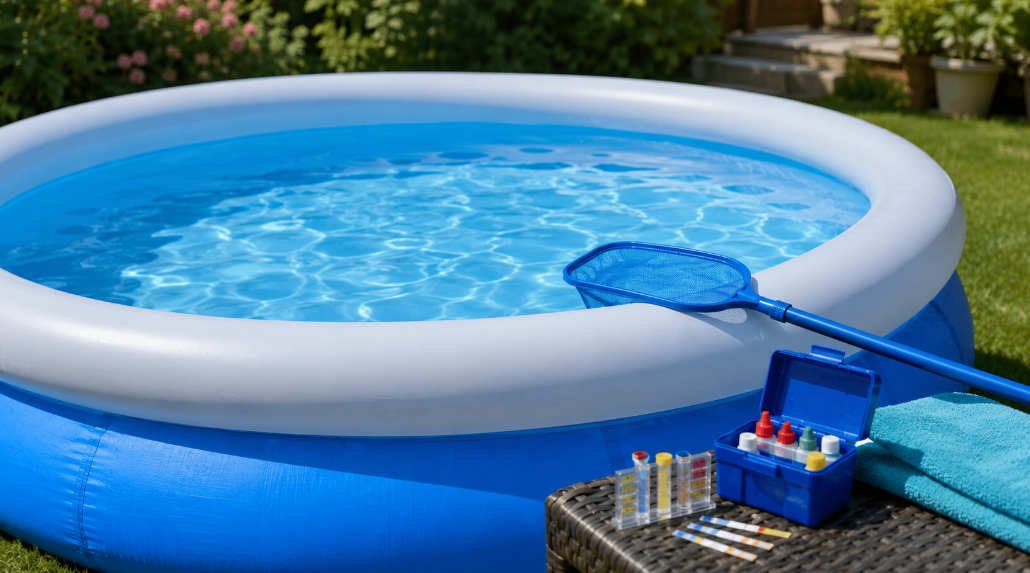
Small children’s pools are often designed to be filled, used, drained, and cleaned regularly.
They usually have:
No circulation pump
No filtration
No controlled disinfectant system
Low water volume
Frequent contact with grass and soil
Young users who may swallow water
Because the water is not continuously treated, contamination can build up quickly.
A large family pool may hold enough water that daily replacement is impractical.
These products may use:
Circulation pump
Filter cartridge
Pool cover
Debris net
Water-testing kit
Approved water-care system
Bottom-cleaning equipment
The water may remain usable for an extended period only when the complete maintenance system works correctly.
| Pool Condition | General Approach |
|---|---|
| Small pool without filter | Drain daily or every one to two days |
| Heavy dirt after one use | Drain immediately |
| Diaper leakage or fecal contamination | Stop use and replace the water |
| Cloudy or unpleasant-smelling water | Do not continue swimming |
| Large pool with filtration | Maintain and test according to instructions |
| Pool unused for several days without treatment | Drain, clean, and refill |
| Slippery walls or visible algae | Empty and clean before reuse |
Visible clarity is helpful, but clear water is not automatic proof that the water is hygienic.
Every swimmer introduces material into the pool.
Common contaminants include:
Sweat
Soil
Grass
Sunscreen
Body oils
Hair
Insects
Leaves
Food residue
Rainwater
Microorganisms
Warm outdoor conditions can encourage algae and microbial growth when water is not circulated and maintained.
A fitted cover helps reduce the amount of leaves, insects, and airborne debris entering the water.
It can also slow evaporation and reduce direct sunlight reaching the pool.
A cover does not replace filtration, testing, or supervision. It must also be removed completely before anyone enters the pool.
Rain changes the water level and may carry dirt into the pool.
After heavy rain, inspect the water, sidewalls, ground condition, and chemical balance before reopening a larger maintained pool.
Simple habits can reduce the contamination load.
Before entering the pool:
Rinse feet
Remove soil and grass
Avoid swimming when ill
Clean toys
Use suitable swim diapers where required
Keep food outside the pool
Shower when practical
These actions do not make the water sterile, but they reduce how quickly it becomes dirty.
Use a net to remove visible debris after every swimming session.
For larger pools, inspect and clean the filter according to the equipment instructions. A clogged filter cannot circulate water effectively.
The bottom and corners also require attention because settled dirt may not float to the surface.
Do not wait for the planned maintenance day when the water shows a clear problem.
Drain and clean the pool when:
The water is cloudy
The surface feels slimy
A strong unpleasant odor develops
Algae is visible
The filter has stopped working
Animals have entered the water
Fecal contamination has occurred
Large amounts of soil or debris are present
The owner cannot verify water quality
When uncertain, replacing the water is safer than allowing continued use of a small untreated pool.
Only use a pool-treatment product when the pool size, equipment, material, and instructions support it.
Adding chemicals by guesswork can create unsuitable concentrations and may damage the liner or irritate users.
For a small pool designed for frequent draining, changing the water may be more practical than establishing a chemical-treatment program.
For a larger pool, follow the pool, pump, filter, testing-product, and treatment instructions together.
Different pool and household chemicals should never be mixed unless the product instructions specifically direct it.
Store all treatment products away from children, heat, food, and moisture.
After draining:
Remove remaining debris.
Wash the interior with a suitable mild cleaner.
Pay attention to folds and corners.
Rinse away all cleaner.
Allow the surface to dry when the pool will be stored.
Inspect seams, valves, and the drain.
Do not fold and store the pool while it is damp. Trapped moisture can contribute to odor, mildew, and surface damage.
One liter of water weighs approximately one kilogram.
This means a large pool places substantial load on the ground beneath it. The installation surface should be level and able to support the full pool without settling or damaging the surrounding area.
Do not move or drag the pool after it has been filled.
A Large Family Inflatable Pool should have dimensions and maintenance features appropriate for the intended use.
Buyers should confirm:
Total water capacity
Recommended fill line
Drain position
Pump compatibility
Filter connection
Cover availability
Number of air chambers
Valve type
Ground protection
Repair kit
User and safety information
A larger pool provides more space but also increases water, setup, drainage, and maintenance requirements.
Our inflatable-pool range includes children’s paddling pools, Square Pools, large family pools, pools with seats, shaded Toy Pools, portable pools, and customized shapes.
We support OEM and ODM projects through our design, engineering, quality-control, and workshop teams.
Buyers can customize dimensions, colors, printed graphics, air chambers, valves, drain fittings, repair accessories, and retail packaging.
Send us the inflated dimensions, target water capacity, user age group, material, chamber structure, filter requirement, drain, cover, artwork, packaging, and quantity.
We will prepare a Large Family Inflatable Pool configuration for sample testing and market evaluation.
 Mobile Phone:
 Phone:
 Contact Now
 Youtube