
An Inflatable Pool can be worth buying when the goal is affordable, temporary water recreation without constructing a permanent swimming pool. It can turn a backyard, patio, holiday property, or event space into a usable water-play area within a short time.
However, the value depends on how often the pool will be used, who will use it, how much maintenance the owner accepts, and whether the available space is suitable. A small children’s paddling pool and a large family inflatable pool have very different setup and water-care requirements.
The best way to judge the purchase is to compare convenience with the complete cost of ownership.
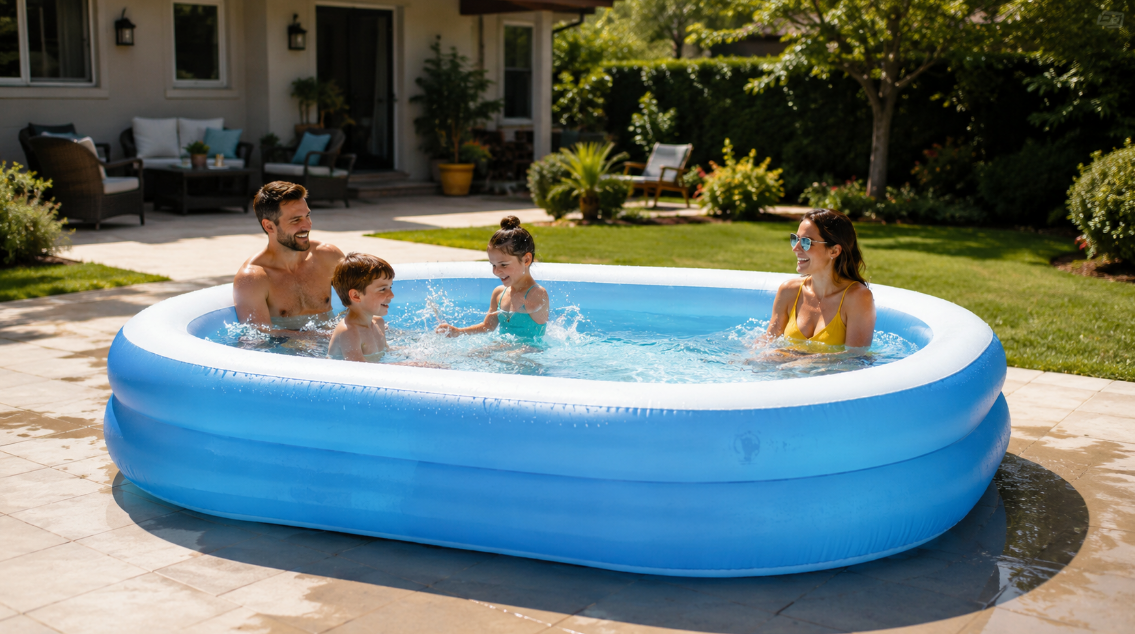
Inflatable pools appeal to buyers because they require less construction and financial commitment than permanent pools.
Common advantages include:
Lower initial purchase cost
Fast setup
Seasonal use
Easier storage
Multiple sizes and shapes
No permanent structural alteration
Suitable options for children and families
Custom colors and printed designs
For renters or households that may move, portability can be more valuable than long-term installation.
A family that wants a pool only during the hottest weeks of summer may not need a permanent structure.
The pool can be inflated when required, drained after the season, cleaned, and stored indoors. This keeps the outdoor space available for other uses during the rest of the year.
An inflatable pool may appear inexpensive, but buyers should also consider accessories and maintenance.
Possible additional costs include:
| Cost Area | Typical Requirement |
|---|---|
| Inflation | Manual or electric air pump |
| Ground protection | Mat, tarp, or foam underlay |
| Water care | Cover, net, testing products, or filtration |
| Maintenance | Cleaning tools and repair patches |
| Access | Ladder for taller models |
| Storage | Dry indoor storage space |
| Replacement | Valves, plugs, or damaged sections |
For a small pool that is drained frequently, filtration may not be necessary. A larger model holding a significant volume of water normally requires more organized maintenance.
The pool should be installed on a flat, stable surface free from sharp stones, roots, tools, and debris.
Measure more than the external dimensions of the inflated product. Additional clearance is needed for:
Entry and exit
Adult supervision
Water drainage
Pump or filter equipment
Walking space
A protective ground mat
Cleaning access
Safe distance from electrical equipment
Do not position the pool on a slope. Uneven water pressure may distort the walls and place excessive stress on seams.
Durability depends on the material, thickness, seam construction, valve quality, inflation pressure, ground condition, and storage method.
Common causes of premature damage include:
Overinflation
Sharp objects beneath the floor
Pets scratching the sidewall
Dragging the pool while inflated
Leaving it in strong sunlight for long periods
Folding it while damp
Storing it near heat or chemicals
Using an unsuitable repair adhesive
A heavier material does not guarantee better performance if the welded seams or valves are poorly made.
A pool with independent chambers may retain more of its shape when one section loses pressure.
Separate chambers also allow different parts of the pool to be inflated gradually. Each chamber should be checked before filling the pool with water.
Water can quickly collect leaves, soil, insects, sunscreen, body oils, and other contamination.
A small filterless pool may need frequent draining and refilling. Larger pools can keep water longer when they use appropriate circulation, filtration, covering, and water-quality control.
A pool that is not maintained can become cloudy, slippery, unpleasant, and difficult to clean.
A practical drain valve should be positioned where water can be directed away from buildings, electrical systems, neighboring property, and areas vulnerable to erosion.
The drainage route should be planned before filling the pool because even a relatively shallow family pool can hold a large amount of water.
An inflatable pool is still a body of water, even when it is shallow.
Children require continuous adult supervision. Pool floats, rings, seats, and Inflatable Toys do not replace a capable supervisor or an approved personal flotation device.
The pool should also be secured against unsupervised access when it contains water.
Air pumps, filtration equipment, extension cords, lighting, and other electrical products must be kept and operated according to their instructions.
Damaged cables or unsuitable outdoor connections should not be used near water.
It is likely to provide good value when:
The household needs seasonal recreation
The ground is flat and suitable
Storage space is available
Users accept routine cleaning
An adult can supervise children
The size matches the available water supply
The pool can be drained responsibly
A permanent installation is unnecessary
Another solution may be better when:
The pool will be used daily for many years
The site has no level installation area
Water restrictions make regular refilling difficult
The owner cannot maintain water quality
There is no secure storage location
Unsupervised access cannot be prevented
The user needs structured lap swimming
The pool must remain available throughout the year
A framed above-ground or permanent pool may offer better long-term value for intensive use, although it also requires more investment and maintenance.
For distributors and private-label brands, an inflatable pool should be evaluated by more than its printed appearance.
Important purchasing specifications include:
Inflated dimensions
Recommended water depth
PVC or other material specification
Number of air chambers
Valve structure
Welded seam quality
Drain location
Repair accessories
Warning labels
Packaging size
A Custom Inflatable Pool can be developed for family recreation, children’s water play, promotional use, resorts, or seasonal retail collections.
We manufacture inflatable pools, Swimming Rings, pool floats, Ice Bath Tubs, inflatable beds, sofas, toys, and related vinyl products.
Our team includes design, engineering, quality-control, and production departments. We support OEM and ODM orders involving dimensions, colors, printing, valves, shapes, accessories, and packaging.
Our inflatable-pool category includes square pools, children’s pools, large family pools, toy pools, and custom designs for different markets.
Send us the required size, user group, material, number of chambers, drain structure, colors, printed artwork, accessories, packaging, and order quantity.
We will prepare a Custom Inflatable Pool proposal for sample development and production review.
 Mobile Phone:
 Phone:
 Contact Now
 Youtube